

A HUMANIST TREATISE ON NAVAL ARCHITECTURE AND NAVIGATION IN THE ANCIENT WORLD,
FROM THE LIBRARY OF NAVAL OFFICER AND HISTORIAN IRA DYE
BAÏF, Lazare de and Antonio TELESIO. Annotationes in L. II. De captivis, & postliminio reversis: in quibus tractatur de re navali. Eiusdem annotationes in tractatum De auro & argento leg. quibus vestimentorum & vasculorum genera explicantur. Antonii Thylesii De coloribus libellus, à coloribus vestium non alienus. Edited by Charles Estienne. Paris: Robert Estienne I, 12 September 1549.
2 parts in one volume, quarto in 8s (226 x 167mm), pp. i: [1-2 (title, verso blank)], 3-6 (dedication and address to the reader by Charles Estienne), 7-152; ii: [2 (part-title ‘De re vestiaria’, verso blank)], [6 (dedication and prefatory text)], 1-90, [91-92 (section-title ‘De vasculis’, verso blank)], [93]-94 (dedication), 95-156, [157 (section-title ‘Antonii Thylesii Consentini Libellus de coloribus’)], 158 (address to the reader), 159-176, [9 (diglot index)], [1 (errata)], [2 (colophon, verso blank)]. Roman, italic, and Greek types. Woodcut printer’s device on title (P. Renouard, Les marques typographiques parisiennes des XVe et XVIe siècles, 295). 27 woodcut illustrations in the text, 19 full-page. Woodcut initials and woodcut diagrams in the text. (Occasional light marking, some ll. with light, marginal ink- or damp-marking, short marginal tear on A1 and A2.) Early limp vellum, yapp fore-edges, spine with traces of paper labels and lettered in ink by a later hand. (Marked and cockled, lacking ties, splitting on hinges, bookblock shaken and partially detached.) A very good copy. Provenance: David Freebairn, Edinburgh (auctioneer, sold to:) – John Trotter, 5th of Mortonhall,Mortonhall, Midlothian, January 1701 (1667-1718, note on upper flyleaf ‘[?lot no.] 119) bought at Mr D. Freebairn’s auction Ed[inbu]r[gh] Jan. 1701’; by descent to:) – [?]Thomas Trotter, 7th of Mortonhall, Mortonhall, Midlothian (1762-1793, engraved armorial bookplate of the Trotter family on inside upper cover [Lee, Scottish Bookplates, p. 74]) – Captain Ira Dye USN, retired (1918-2006, engraved booklabel on inside upper cover) – item 10 in a British bookseller’s catalogue (loosely-inserted clipped post-decimalisation description priced £175.00; probably purchased by:) – Stephen John Keynes OBE, FLS (1927-2017).
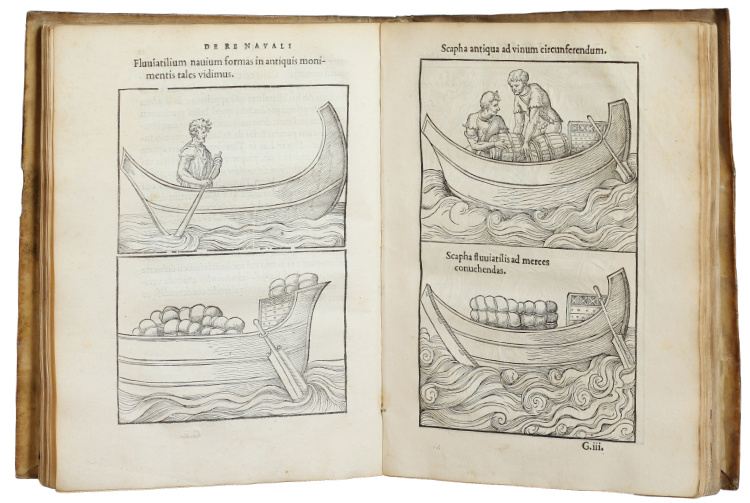
Second Estienne edition. The French humanist scholar and diplomat Lazare de Baïf (1496-1547) was one of King François I’s Conseillers du roi and an ambassador to Venice. Among his literary works, he translated four of Plutarch’s Βίοι Παράλληλοι into French and produced a French translation of Sophocles’s Ἠλέκτρα in alexandrines. His son, Jean Antoine de Baïf (1532-1589) was taught Latin by Charles Estienne, and became a noted French poet, who was a friend of Pierre de Ronsard and member of the Pléiade. Lazare de Baïf’s interest in the classical era extended to its history and culture, and this collection of works, which was first published by Estienne in 1536, gathers three of these titles. The first is De re navali, which was first published in this collection in 1536, and is a study of naval architecture and navigation in the ancient world, and the other two – De re vestiaria and De vasculis – are treatises on ancient costume and vases respectively, which were edited by Charles Estienne from Baïf’s works on the two subjects published at Basel in 1526 and 1531 respectively. Charles Estienne’s editions were intended for the use of both juvenile and adult audiences, and were first published separately in 1535, before they were collected under the present title.
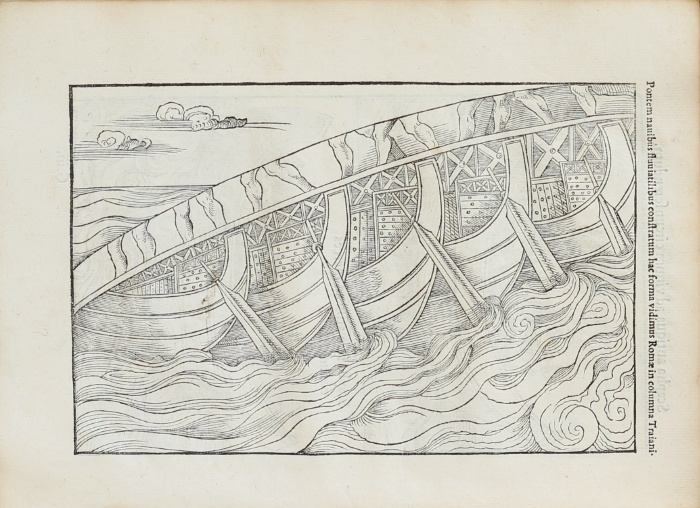
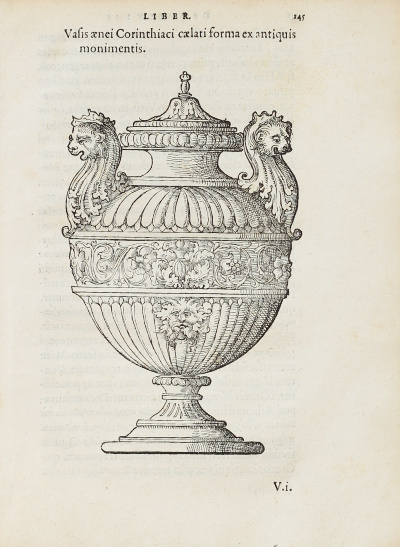
These three works on classical engineering, fabrication, and arts are supplemented by De coloribus libellus, by the Italian humanist scholar, philologist, and poet Antonio Telesio (1482-1534). Antonio Telesio was born in Cosenza, but left in c. 1517 for Milan, where he was responsible for the education of his nephew, the philosopher Bernardino Telesio. A few years later Antonio Telesio moved to Rome, which he fled in 1527 for Venice to escape the invading forces of the Holy Roman Emperor, Charles V. At Venice in 1528 Telesio composed and published De coloribus libellus – a seminal monograph on colours, which examined the Latin terminology for colours. De coloribus libellus was repeatedly republished and translated throughout the following centuries; perhaps most notably, nearly three centuries after its first appearance, the Latin text was reprinted in its entirety in the second volume of J.W. von Goethe’s Zur Farbenlehre (Tübingen, 1810).
The volume is illustrated with numerous woodcuts, which were, according to Charles Estienne’s preface, based upon ancient monuments (particularly those surviving in Rome). Bernard notes that four of the woodcuts were signed with Robert Estienne’s device of the cross of Lorraine (that on p. 22 of De re navali, which is repeated on p. 152, and those on pp. 3, 38, and 55 of De re vestiaria), but that all of the remaining woodcuts, although not signed, were from the studio of Geofroy Tory. Following the completion of the first edition of this collection in 31 August 1536, Baïf sent a copy to his associate Erasmus, evidently unaware of the death of the great humanist on 12 July 1536; as van Gulik notes, the author ‘must have sent a copy of his book to Basel immediately after its publication. The copy was conscientiously added to Erasmus’ estate by his executor Bonifacius Amerbach’ (E. van Gulik, Erasmus and his Books (Toronto, 2018), ‘The Versandliste: An Annotated Catalogue’, no. 245). The work was then republished in this edition in 1549, two years after Baïf’s death.
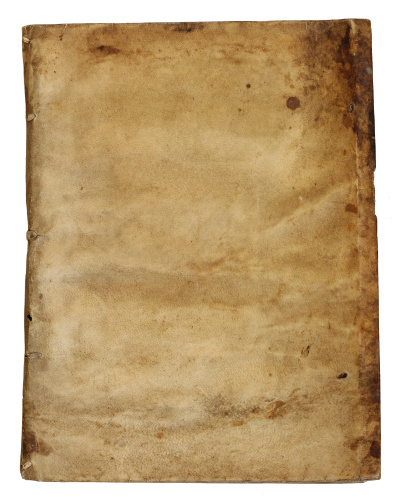
This copy is bound in limp vellum, which appears to predate its sale by auction by David Freebairn in Edinburgh in January 1701, when it was purchased by the Scottish book collector John Trotter of Mortenhall. The upper flyleaf bears his purchase inscription, which is typical of those found on other books from the Trotter family library purchased in his lifetime, such as the Clark Library’s copy of Guy Miege’s The English Grammar (London, 1691), ‘bought from George Mesman bookseller in Edinr. ye 20 Jan [16]95’; King’s College, London’s copy of Dissertationum ludicrarum et amoenitatum scriptores varii (Leiden, 1638), ‘Cost 10. d at Dr. Scattergoods auction London aug. 1697’; and the University of Pennsylvania’s copy of Aristotelis liber, qui decimus Historiarum inscribitur (Paris, 1584), ‘Bought at an auction […] in Jan. 1712’. It also bears the bookplate of the Trotter family of Mortonhall, which Lee considers of ‘unusual elegance’ and posits was ‘probably’ used by Thomas Trotter (1762-1793), 7th of Mortonhall. This copy probably remained in the library of the Trotter family until 1947, when there were two sales of books from the Trotter library, the first held by Christie’s (10 February 1947) and the second at Dowell’s Auction Rooms, Edinburgh (30 September 1947).

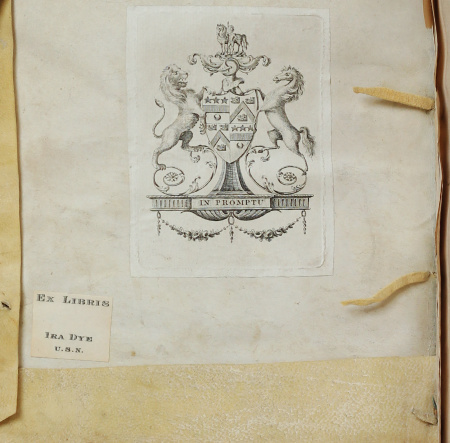
Presumably in the latter half of the twentieth century this copy was acquired by the noted naval officer and historian Ira Dye, who studied chemical engineering at the University of Washington and was commissioned into the US Navy following his graduation in 1940. Dye served as a submariner in the Pacific theatre during World War II and commanded the submarine Seafox in the Korean War, before taking up the position of Commander, Submarine Division 52 and serving on the Joint Staff of the Joint Chiefs of Staff at the Pentagon. He subsequently moved to the Maritime Administration and then the Department of Transportation, before departing administrative work for academia, joining the University of Virginia in 1978 as a Visiting Professor of Civil Engineering, becoming Research Professor of Civil Engineering and Director of the Research Laboratories for the Engineering Sciences. After retiring in 1984, Dye was able to pursue his interest in naval history more fully, concentrating on the social and cultural history of American and British seafarers from 1790 to 1820 and publishing The Fatal Cruise of the Argus: Two Captains in the War of 1812 (Annapolis, MD, 1994), Uriah Levy: Reformer of the Antebellum Navy (Gainesville, FL, 2006), and a number of scholarly articles. In 2006 Dye donated his collection of books and manuscripts on the subject to USS Constitution Museum.
This copy was later in the library of the noted bibliophile Stephen Keynes, a great-grandson of Charles Darwin, the founder and chairman of the Charles Darwin Trust, and, like his father Sir Geoffrey Keynes, a member of the Roxburghe Club.
H.M. Adams, Books Printed on the Continent of Europe, 1501-1600, in Cambridge Libraries, B-37; Katalog der Ornamentstichsammlung der Staatlichen Kunstbibliothek, Berlin, 885; A. Bernard, Geofroy Tory (1863), pp. 269-270; A. Pettegree and M. Walsby, French Books III & IV, Books published in France before 1601 in Latin and Languages other than French, 55640; B.M. Cooper, Catalogue of the Scott Collection, 5 and 6; T. Peach and B. Drecq, Catalogue descriptif des éditions françaises, néo-latines et autres, 1501-1600, de la Bibliothèque municipal de Poitiers, 98 (apparently erroneously calling for 8ll. in the final quire Y); A.A. Renouard, Annales de l’imprimerie des Estienne (1843), p. 75, no. 22.
£995
· · · · · · · · · · · · · · · · · · · · · · · · · ·
Our Terms & Conditions apply.