

‘JAMES BOND’S MOST SERIOUS RIVAL…’ – THE FIRST EDITION IN HAWKEY’S DUSTWRAPPER
DEIGHTON, Leonard Cyril (‘Len’). Funeral in Berlin. London: Ebenezer Baylis and Son, Limited for Jonathan Cape, 1964.
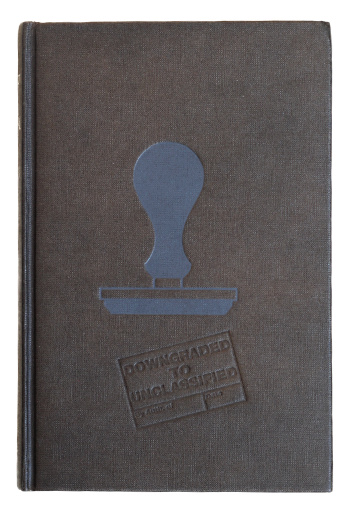
Octavo in 16s (189 x 125mm), pp. [8], 9-319, [1 (unnumbered final text l.)]. Original dark brown cloth by A.W. Bain and Co. Ltd., upper board with stamp design blocked in blue and ‘downgraded to unclassified’ stamp blocked in blind, spine lettered and with publisher’s device in gilt, black-and-white document-facsimile design endpapers, black-and-white dustwrapper designed by Raymond Hawkey repeating the ‘downgraded to unclassified’ stamp motif on the rear panel, with Jonathan Cape’s decorative clip of corners, not price-clipped. (Extremities lightly rubbed and bumped, dustwrapper lightly rubbed and creased at edges, spine slightly darkened, a few spots on verso.) A very good copy in the dustwrapper.

First edition. Funeral in Berlin continues the story of Deighton’s unnamed spy who became known as ‘James Bond’s most serious rival’ (Queen magazine, cited on the dustwrapper) from Deighton’s successful debut novel, The Ipcress File(1962). This ‘Secret File No. 3’ was followed by Horse Under Water (1963).
Len Deighton (b. 1929) had served in the Royal Air Force during World War II, gathering experiences that would influence his writing significantly. Before becoming a writer, he trained at St Martin’s School of Art and the Royal College of Art to become, alongside other jobs, a successful commercial artist in London and New York. He started to write his first novel, The Ipcress File, ‘as a lark on vacation in France in 1960’, and it was published following a ‘chance conversation with a literary agent’ two years later (‘Len Deighton’, EBSCO).
In 1966 Life magazine described the 37-year-old Deighton ‘currently the hottest author in Britain, to be geographically modest’, whose Funeral in Berlin had ‘remained on the best-seller list of the New York Times for 20 weeks during the first half of 1965. Funeral is Deighton at his best’ (Hugh Moffett, ‘Spy Writer on the Lam’, Life, 25 March 1966, pp. 85-97, at p. 86). Indeed, together with Yesterday’s Spy (1965), Funeral in Berlin is considered ‘the most successful of this series’ of spy novels to this day. It is said that, ‘[d]rawing upon a tradition of realistic spy fiction pioneered by writers W. Somerset Maugham, Eric Ambler, and Greene, Deighton and his contemporary John le Carré have revolutionized the genre’ (EBSCO). (Interestingly, the quote from the New Statesman on the dustwrapper misspells Greene’s name, stating that ‘[t]here has been no brighter arrival on the shady scene since Graham Green [sic] started entertaining’.)
The film version of Funeral in Berlin was produced by James Bond film producer Harry Saltzman in 1966, starring Michael Caine in the lead role. In this and all other film adaptations of Deighton’s spy novels from this series, the (anti-)hero spy is named ‘Harry Palmer’.
This first edition of Funeral in Berlin was published in September 1964 in an edition of 14,000 copies (cf. Martin Breese, Breese’s Guide to Modern First Editions (London 1993), p. 108). This copy does not include the copy of Deighton’s passport in an envelope, which ‘was issued only to the book trade’ (Breese, p. 108) and is very rare.
£125
· · · · · · · · · · · · · · · · · · · · · · · · · ·
Our Terms & Conditions apply.