

ANTI-UTOPIAN FORSTER: HIS COLLECTED FANTASTIC SHORT STORIES, DEDICATED TO T.E. LAWRENCE,
IN THE SCARCE DUSTWRAPPER
FORSTER, Edward Morgan. The Eternal Moment and other Stories. London: Turnbull & Spears for Sidgwick & Jackson, Ltd., 1928.
Octavo (183 x 134mm), pp. 5 (half-title, author’s works, title, imprint, dedication, blurb, contents)], [1 (blank)], 188. Laid paper watermarked ‘Antique Laid’. Original maroon cloth gilt, upper board lettered in gilt with triple-ruled gilt frames around title and author’s name, all within triple-ruled gilt border, spine lettered and with triple rules in gilt, grey-blue dustwrapper lettered in black and with double-ruled and single-ruled frame on front and back panel, dustwrapper price-clipped at bottom of upper flap with matching diagonal trim at top. (Extremities lightly rubbed and bumped, very light spattered marking on boards, dustwrapper lightly marked, faded on spine, rubbed at edges causing small losses, and with short tear.) A very good copy, in the scarce dustwrapper.
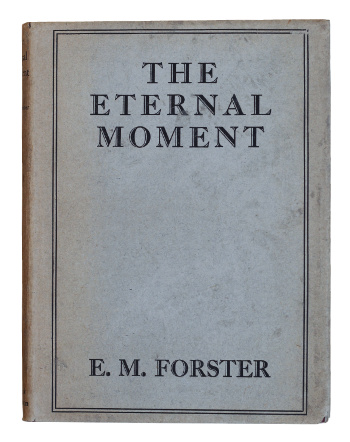
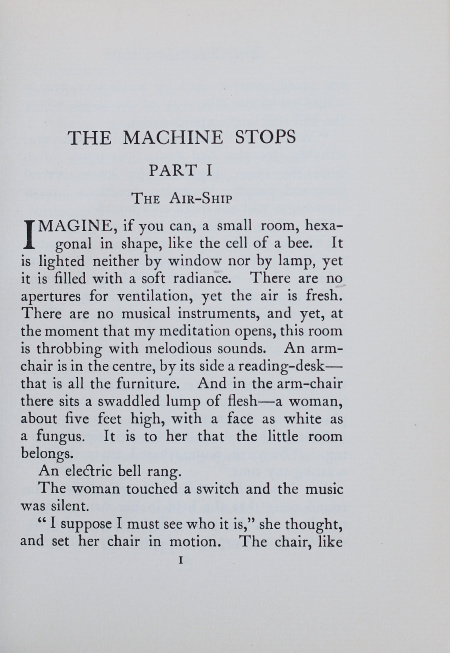
First edition, first issue. Following the publication of the short story collection The Celestial Omnibus in 1911, the novelist and essayist E.M. Forster (1879-1970) wrote the supernatural and science-fiction stories gathered in The Eternal Moment from 1914 onwards. As the prefatory note explains, ‘The Story of the Siren’ was first published as a separate publication by the Hogarth Press (1920), while others appeared in literary periodicals and magazines of the time. In the present collection, however, the stories were considered to complete ‘all that the writer is likely to attempt in a particular line’ (p. [6]). Notably, the final story, ‘The Machine Stops’ (1909), has been considered ‘the first full-scale emergence of the twentieth-century anti-utopia’ paving the way for Huxley and Orwell (Mark Robert Hillegas, The Future as Nightmare: H. G. Wells and the Anti-Utopians (New York, 1967), p. 82). Forster himself describes it in the Introduction to his Collected Short Stories (London, 1947), in which it was republished, as ‘a reaction to one of the earlier heavens of H.G. Wells’ (p. vii).
Forster dedicated the volume to T.E Lawrence, with whom he had established a literary friendship after reading Siegfried Sassoon’s copy of the 1922 edition of Seven Pillars of Wisdom, visiting Lawrence at Clouds Hill and advising on revisions of the text. The two men continued to stay in touch and embarked upon a correspondence (which lasted for the remainder of Lawrence’s life), in which they often discussed their respective writings. Regarding the dedication in The Eternal Moment, Forster wrote to Lawrence:
The dedication [‘To T. E. In the absence of anything else’] can be given a wrong meaning, which you will enjoy doing, and I shall like to think of you doing it. The matter is decided therefore. […] If you ever inscribe anything to me, either good bad or indifferent, I shall be a lot annoyed. (This too can be given a wrong meaning. Care to have a try?)’ (A.W. Lawrence (ed.). Letters to Lawrence (London, 1962), p. 66).
The Eternal Moment was published in an edition of c. 3,720 copies on 27 March 1928 and sold at a price of 5s. The American edition of 2,000 copies followed on 19 April and proved so popular that another 1,000 copies were printed in July of the same year.
E.F. Bleiler, Guide to Supernatural Fiction 646; B.J. Kirkpatrick, A Bibliography of E.M. Forster (1985), A13a; P. O’Brien, T.E. Lawrence (2000), F0361.
£250
· · · · · · · · · · · · · · · · · · · · · · · · · ·
Our Terms & Conditions apply.