

FIRST EDITION, FIRST ISSUE OF THE MAN WITH THE GOLDEN GUN
FLEMING, Ian Lancaster. The Man with the Golden Gun. London: Richard Clay (The Chaucer Press), Ltd for Jonathan Cape, 1965.
Octavo (181 x 125mm), pp. [i]-v, [6-8 (blank, section title, blank)], 9-221, [1 (blank)], [2 (final blank l.)]. (Occasional very light spotting, a few very light marks.) Original black Type C (Excelin) cloth, spine lettered and with publisher’s device in bronze, green patterned endpapers [Gilbert’s second state ‘Binding B’], dustwrapper with trompe-l’œil design by Richard Chopping with Jonathan Cape’s decorative clip of corners, not price-clipped. (Corners slightly bumped, spine slightly leant, dustwrapper very lightly spotted and rubbed, edges slightly creased with minor chipping, top of front panel with short tear.) A very good copy.
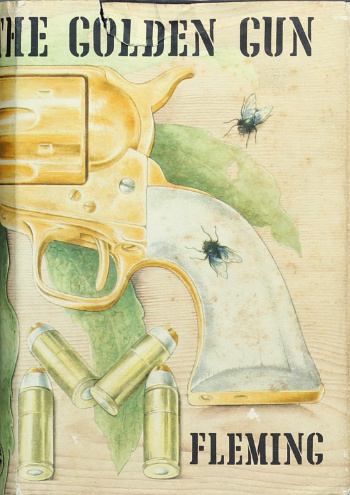
First edition, first issue, second state, binding B. ‘Written at Goldeneye [Fleming’s house in Jamaica] in early 1964, The Man with the Golden Gun, like several of the previous James Bond novels, is set in the author’s adopted home of Jamaica. The plot concerns Francisco Scaramanga and an assorted collection of hoods who plan to sabotage the island’s bauxite trade, deal arms to Castro, smuggle narcotics into America, and ruin the Jamaican sugar industry by setting the cane fields ablaze, thus increasing the value of Cuban sugar. Ian Fleming was well accustomed to the sugar business. His confidante Blanche Blackwell was born into a family of sugar traders and his close friend Jock Campbell was a sugar plantation director in British Guiana. Fleming’s Jamaican property was close to the Drax Hall sugar estate which belonged to the eighteenth century Gothic novelist William Beckford, and in Fleming’s debut novel Casino Royale James Bond passes himself off as a member of the Jamaican “plantocracy”. Tony Hugill, a character in the story, is described as a former Navy Commando and now a sugar planter; the actual Tony Hugill served in Fleming’s élite 30AU, and later ran Jamaica’s cane fields for the sugar giant Tate & Lyle. In The Man with the Golden Gun, we are also reminded of 007’s earlier adventures via the gangsters gathered together by Scaramanga, hailing from the mobs out of Chicago, Detroit and Las Vegas, which were previously described in Diamonds are Forever and Goldfinger, and mentioned again in Thunderball; the hoods’ conference is very similar to that seen in Fleming’s bullion-smuggling novel, and the half-built hotel with Bond girl Mary Goodnight being addressed as “Bimbo” are somewhat reminiscent of Vivienne Michel and “The Dreamy Pines Motor Court” from The Spy Who Loved Me. In addition, Scaramanga shoots defenceless birds, much as von Hammerstein did in For Your Eyes Only or “The Robber” did in Live and Let Die. At the end of the case James Bond is awarded (but refuses) a knighthood for services to his country, a similar decoration being declined upon completion of the earlier Moonraker assignment’ (Gilbert, p. 412).
In this copy, the printing error recorded by Gilbert for p. 132, l. 18 (the occasionally battered appearance of the letter ‘g’ in the only word in the line, ‘gun’, apparently caused by deterioration in later impressions), is not present, suggesting that this might be an earlier impression. Gilbert notes that 81,890 copies of the first edition were bound for publication. This example is the second state of the design (without the golden gun blocked on the upper board), and one of 45,000 copies in Gilbert’s ‘Binding B’ of Excelin bookcloth that had been recorded by March 1965 (but ‘[t]he final figure is likely 46,607’), with the spine blocked in bronze and green patterned endpapers. Although Gilbert proposes a chronological order for the bindings, he does not assign priority, since ‘all of the second state bindings A-D were available in shops upon the date of publication’ (p. 419).
J. Gilbert, Ian Fleming: The Bibliography, A13a(1.3).
£195
· · · · · · · · · · · · · · · · · · · · · · · · · ·
Our Terms & Conditions apply.