
Sydney Parkinson (artist). ‘Plate 475. Nertera granadensis (Linnaeus f.), Druce, Nertera depressa’. London: Alecto Historical Editions in association with the British Museum (Natural History), 1980-1990.
Engraving by William Tringham, printed à la poupée by Alecto Historical Editions. Platemark circa 295x 460 mm, printed on acid-free Somerset mould-made 300gsm paper manufactured by the Inveresk Paper Company. The sheet is watermarked ‘AHE’, measures 561 x 709mm, and bears blind embossed stamps incorporating the publisher’s and printer’s chops, the copyright symbol, and date of publication; the initials of the individual printer, the plate number, and the edition number are recorded in pencil. The engraving is protected by a bifolium of acid-free Somerset mould-made 300gsm paper, cut to form a window mount on which is recorded the modern and Banksian name of the plant, the location and date of its collection and the names of the artists and engraver.
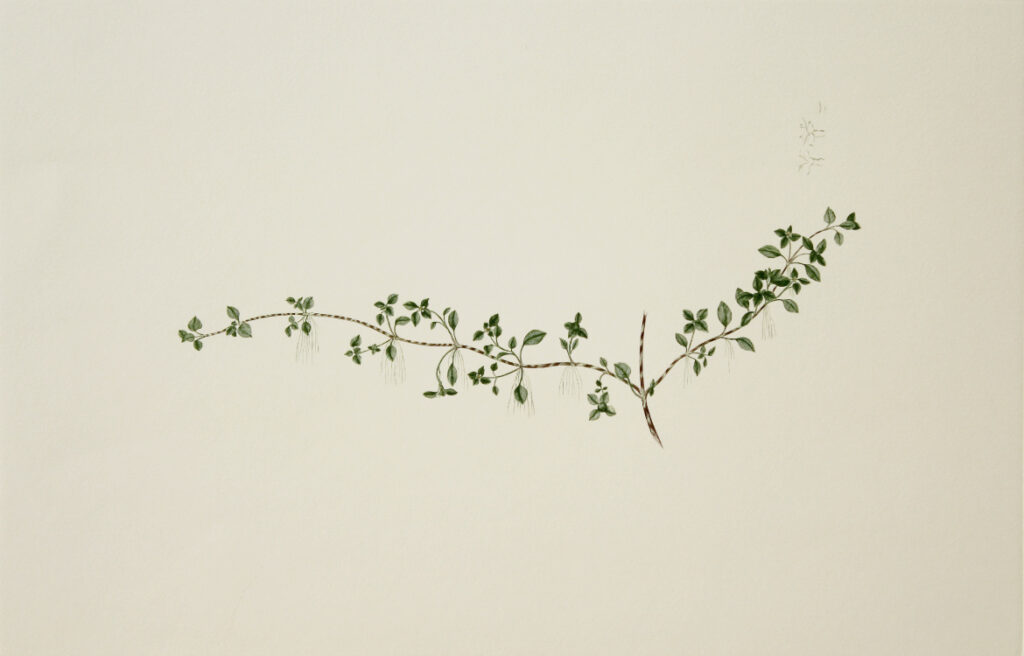
NERTERA GRANADENSIS (LINNAEUS F.)
DRUCE
NERTERA DEPRESSA
Species collected at Totara nui, New Zealand
15 January – 6 February 1770
Limited to 116 copies, this no. 33 of 100 standard copies
At Totara nui – which they found nearly impenetrable due to the thick vegetation – Cook, Banks, and Solander had much opportunity to research both plants and the onward route for HMB Endeavour. Banks noted in his journal that ‘[w]hile Dr Solander and Myself were botanizing the captn went to the top of a hill and in about an hour returnd in high spirits, having seen the Eastern sea and satisfied himself of the existence of a streight communicating with it, the Idea of which had Occurd to us all from Tasmans as well as our own observations’ (22 January 1770). It was during one of these intense botanical explorations that they came across the Nertera granadensis.
A widespread subshrub of the family Rubiaceae, the Nertera granadensis is found not only in New Zealand’s North and South Islands, but also in Madagascar, across tropical and subtropical Asia to the Pacific, in the Caribbean, all the way from Mexico to the south of South America, and even as far as the Subantarctic Islands. It produces small green and yellow flowers, which can be seen in the engraving. However, Banks and Solander appear to have missed the season when the plant produces the many bright red, round fruits which lend it its common name of coral bead plant.
Although not recorded on the mount, Frederick Polydore Nodder does seem to have prepared a watercolour of the plant for Banks’ Florilegium which survives in the Natural History Museum’s collections. But while Nodder’s watercolour shows the different states of the plant’s flower and fruit in pen and ink below the image of the plant – where one would expect it – the engraving has rotated them by 90 degrees.
The history of the Florilegium
The seeds for Joseph Banks’ Florilegium had been planted with his earliest expedition: on his return to London from Labrador and Newfoundland, Banks had commissioned the young Scottish natural history artist Sydney Parkinson to draw some of the natural history specimens from the expedition on HMS Niger. On the Endeavour, Banks took both Solander and Parkinson (who sadly died at sea in January 1771) with him as members of his scientific party. On his return to England Banks planned an account of the expedition’s botanical discoveries, and employed a team of engravers to produce copper plates of Parkinson’s drawings. 743 plates were engraved under Banks’ supervision by eighteen engravers over a period of thirteen years, at a cost of more than £7,000. Manuscript descriptions of the specimens were prepared by Daniel Solander, but (apart from some small groups of proof plates) the long-anticipated work remained unpublished at Banks’ death in 1820, nearly fifty years after he had returned from the Endeavour expedition.
On Banks’ death, the engraved copper plates were bequeathed to the British Museum, where they remained in storage until 1900-1905, when monochrome lithographic plates of the Australian flora were made after the original plates (British Museum, Illustrations of Australian Plants, reproducing 320 of the 743 images). The 1973 limited edition (100 copies) of Captain Cook’s Florilegium, edited by Wilfrid Blunt and W.T. Stearn included a small number of engravings printed from the original copper plates in black ink only.
It was not until 1979, following successful trial printings of the plates in colour, that Alecto Historical Editions and The British Museum (Natural History) agreed to jointly publish the full set of 738 plates (five of the original 743 had been stolen), printed in colour à la poupée (i.e. by applying the colour to the plate with a cotton ball, and then adding further colour if necessary with a brush). Only 100 sets of Banks’ Florilegium, which appeared between 1980 and 1990, were printed for sale (of which all were subscribed), together with sixteen further sets, comprising three printers’ proof sets (of which number 1 is at the Royal Botanic Gardens, Kew); three sets printed for exhibition purposes; and ten hors commerce sets (120 plates from set no. VII were sold by Sotheby’s, London in 1988 to benefit the Banks Alecto Endeavour Fellowship, and sets IX and X went to The British Museum, Natural History).
The reception was enthusiastic: The Book Collector (vol. XXXVIII, 1989) considered the Alecto edition ‘a triumph on many scores: a triumph of imagination, to conceive such an enterprise; a triumph of aesthetic sensibility, to realize that plates originally intended to be printed in black could be rendered in colour with such magical beauty, yet true to nature; a triumph of technical skill, to restore the tarnished plates and print them with unerring precision, maintaining the same high standard from first to last . . .; a triumph, above all of tenacity to bring such a colossal enterprise . . . to a final successful conclusion’.
£125 incl. VAT
· · · · · · · · · · · · · · · · · · · · · · · · · ·
Our Terms & Conditions apply.