

‘WAR IS PEACE. FREEDOM IS SLAVERY. IGNORANCE IS STRENGTH’ – ORWELL’S DYSTOPIAN MASTERPIECE
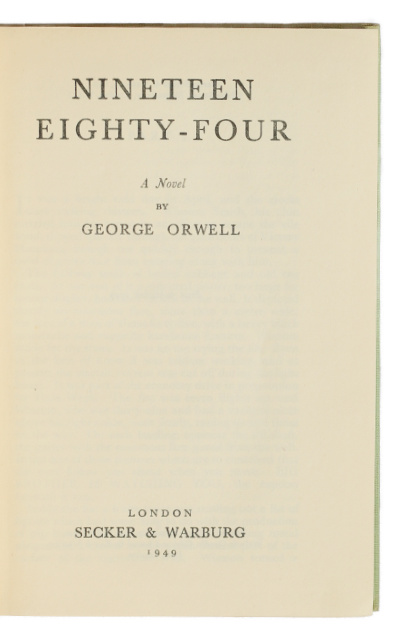
‘ORWELL, George’ [i.e. Eric Arthur BLAIR]. Nineteen Eighty-Four. A Novel. London: The Alcuin Press for Secker & Warburg, 1949.
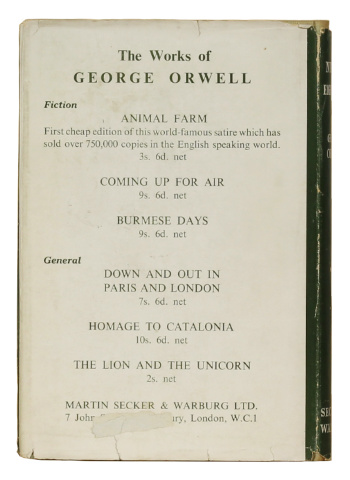
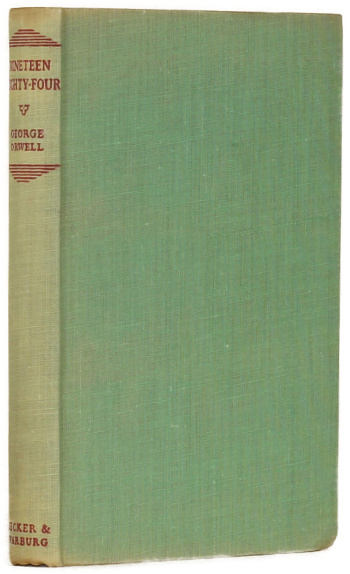
Octavo (184 x 123mm), pp. [1]-[4] (half-title, list of books by Orwell, title, colophon), [5]-312. (Occasional marks, mainly marginal, those on p. 193 possibly production flaws.) Original pale green cloth by Key & Whiting, Ltd., spine lettered and decorated in maroon, top edges stained red, dustwrapper designed by Michael Kennard printed in green, not price-clipped. (Cloth faded on spine and edges of boards, lower corners bumped causing creasing on corner of bookblock, dustwrapper creased at edges and with tears causing small losses, lower panel scuffed with surface loss.) A very good copy. Provenance: ‘7/49 10/-’ (pencilled [?]acquisition note on front free endpaper, indicating that it was purchased in July 1949 at the publication price of 10s.).
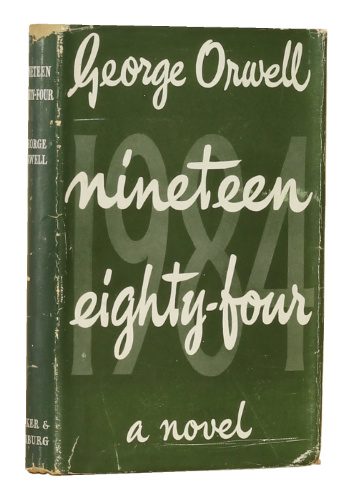
First edition, issue with green dustwrapper (no priority established). George Orwell (1903-1950) had first considered a future dominated by two superstates in 1943 and by early 1944 had learnt of Evgeny Zamyatin’s celebrated dystopian novel We, which was written in 1920-1921 and published in English in 1924 (the original Russian text would only be published in 1952). In a letter of 17 February 1944 Orwell wrote to Gleb Struve expressing his appreciation of We and explaining that ‘I am interested in that kind of book, and even keep making notes for one myself that may get written sooner or later’ (S. Orwell and I. Angus (eds), The Collected Essays, Journalism and Letters of George Orwell. Volume III: As I Please 1943-1945 (Harmondsworth, 1970), p. 118). In the same month Orwell completed his celebrated satire Animal Farm (although difficulties with publishers and paper shortages delayed publication until August 1945), and he began to think more deeply about the form that the post-war world would take, outlining some of the ideas which would underpin Nineteen Eighty-Four in a letter to Noel Willmett on 18 May 1944:
All the national movements everywhere, even those that originate in resistance to German domination, seem to take non-democratic forms, to group themselves round some superhuman fuehrer (Hitler, Stalin, Salazar, Franco, Gandhi, De Valera are all varying examples) and to adopt the theory that the end justifies the means. Everywhere the world movement seems to be in the direction of centralized economies which can be made to ‘work’ in an economic sense but which are not democratically organized and which tend to establish a caste system. With this go the horrors of emotional nationalism and a tendency to disbelieve in the existence of objective truth because all the facts have to fit in with the words and prophecies of some infallible fuehrer. Already history has in a sense ceased to exist, i.e. there is no such thing as a history of our own times which could be universally accepted, and the exact sciences are endangered as soon as military necessity ceases to keep people up to the mark. Hitler can say that the Jews started the war, and if he survives that will become official history. He can’t say that two and two are five, because for the purposes of, say, ballistics, they have to make four. But if the sort of world that I am afraid of arrives, a world of two or three great superstates which are unable to conquer one another, two and two could become five if the fuehrer wished it. That, so far as I can see, is the direction in which we are actually moving, though, of course, the process is reversible (op. cit., p. 177).
In the same month, George Orwell and his wife Eileen adopted a baby, Richard, and domestic and professional matters occupied much of the following months – months which saw the family made homeless by bombing and the consequent moves to flats in Baker Street and then Islington – while Orwell was negotiating the publication of Animal Farm. In February 1945 Orwell relinquished the literary editorship of Tribune and travelled to Paris and then Cologne as a war correspondent for The Observer and Manchester Evening News. In Cologne Orwell received the shocking news that Eileen had died in the course of a routine operation on 29 March 1945, and he returned to England very shortly afterwards. At the beginning of April he travelled back to Paris, where he witnessed VE Day, and continued reporting from France, Germany, and Austria, before returning to England in late May to report on the forthcoming General Election for The Observer. On 3 July 1945, two days before the election, Orwell wrote to his agent, Leonard Moore, about the difficulties caused by the former’s contract with Victor Gollancz, who had first refusal on Orwell’s next two novels. Orwell’s political positions had diverged significantly from those of his publisher over the years since the Gollancz had published Burmese Days in 1935, and in 1944 Gollancz had declined his option on Animal Farm on political grounds. As an example of the problems that the contract might cause in the future, Orwell wrote to Moore that ‘I have recently started a novel [i.e. Nineteen Eighty-Four]. Considering how much work I have to do elsewhere I don’t expect to finish it till sometime in 1947’ (op. cit., p. 444).
By April 1947, following further discussions with Victor Gollancz, the publisher had relinquished his rights to Orwell’s further novels – opening the way for Nineteen Eighty-Four to be published by Secker & Warburg, who had already published other works by Orwell, including the non-fiction work Homage to Catalonia (1938) and Animal Farm (1945). Professional obligations and ill-health meant that progress was not as rapid as Orwell had hoped, but a period on the Isle of Jura enabled him to concentrate on the book. In May 1947 he was able to report to Frederic Warburg of Secker & Warburg that ‘I have made a fairly good start on the book [sc. Nineteen Eighty-Four] and I think I must have written nearly a third of the rough draft’, expressing the ambition that, despite continued illness, ‘when I leave here in October I shall either have finished the rough draft or at any rate broken its back’ (S. Orwell and I. Angus (eds), The Collected Essays, Journalism and Letters of George Orwell. Volume IV: In Front of Your Nose 1945-1950 (London, 1968), p. 329). The first draft was, indeed, finished in October 1947, but in December Orwell was diagnosed with tuberculosis and admitted to hospital.
In the spring and summer of 1948 Orwell was able to revise the novel, with the ambition of finishing it by the end of the year, and, after an extended campaign of writing through the autumn on Jura, he completed it and began retyping it in November 1948. In December it was with Moore and Warburg, in January 1949 Orwell and Warburg settled upon Nineteen Eighty-Four as a title (the alternative had been The Last Man in Europe), and on 8 June 1949 the present first edition of 25,575 copies was published, priced at 10s. The first edition was issued in a binding of green cloth lettered in maroon on the spine and a dustwrapper was designed for the book by Michael Kennard, which is known in two states; the first (as here) is printed in green and the second is printed in red (no priority has been established between the two states). Interestingly, this copy has a pencilled note ‘7/49 10/-’ on the front free endpaper, suggesting that the first owner purchased it in July 1949, shortly after it was published.
The philosopher Bertrand Russell was sent pre-publication proofs of Nineteen Eighty-Four and responded with a prescient critique, which was printed on the dustwrapper: ‘Nineteen Eighty-Four depicts, with very great power, the horrors of a well-established totalitarian regime of whatever type. It is important that the western world should be aware of these dangers, and not only in the somewhat narrow form of fear of Russia. Mr. Orwell’s book contributes to this important purpose with great power and skill and force of imagination. I sincerely hope that it will be very widely read’. The public response to Nineteen Eighty-Four was as enthusiastic as Russell had hoped, and by the end of October 1949 the first edition had been virtually exhausted.
Numerous editions and translations into other languages appeared in the following decades, and the words, phrases, or concepts from the book which have entered everyday speech – such as ‘Big Brother’, ‘Room 101’, and ‘Doublethink’ – testify to the book’s enduring influence. In his 1946 essay ‘Why I Write’ Orwell explained that ‘[w]hat I have most wanted to do throughout the past ten years is to make political writing into an art’ (S. Orwell and I. Angus (eds), The Collected Essays, Journalism and Letters of George Orwell. Volume I: An Age Like This 1920-1940 (Harmondsworth, 1970), p. 28) – with Nineteen Eighty-Four and Animal Farm Orwell established himself as the modern master of that art.
C. Connolly, The Modern Movement (1965), 99; G. Fenwick, George Orwell: A Bibliography, A.12a.
£4,500
· · · · · · · · · · · · · · · · · · · · · · · · · ·
Our Terms & Conditions apply.