
‘THE CONTRIBUTION OF PRINT TO PUBLIC DEBATE AS AN ESSENTIAL PRELIMINARY
TO THE FORMATION OF DEMOCRATIC PUBLIC POLICY’, FROM THE LIBRARY OF STEPHEN KEYNES
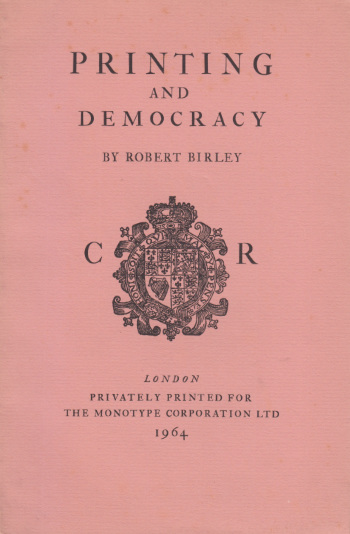
BIRLEY, Sir Robert. Printing and Democracy. London: ‘Privately printed’ by University Press, Oxford ‘for The Monotype Corporation Ltd’, 1964.
Octavo in 4s (248 x 164mm), pp. 29, [1 (blank)], [2 (fly-title ‘Plates’, verso blank)]. Half-tone frontispiece and 4 half-tone plates with illustrations recto-and-verso. Facsimile of woodcut arms of Charles I on title. Original printed wrappers, upper wrapper repeating facsimile arms of Charles I, lower wrapper with imprint. (A few very light spots and marks, lower wrapper creased, spine-ends slightly rubbed and chipped.) A very good copy. Provenance: Stephen John Keynes OBE, FLS (1927-2017).
First edition. A paper by the educator, educational administrator, and bibliophile Sir Robert Birley (1903-1982). Birley was educated at Rugby School and Balliol College, Oxford, before joining the staff of Eton College, where he taught from 1926 to 1935, and ‘developed a lifelong absorption in the magnificent college library, from which he obtained much of his large store of often esoteric knowledge’ (ODNB). In 1935 Birley was appointed headmaster of Charterhouse School, holding the post until 1947, when he was appointed Educational Advisor to the Military Governor, Allied Control Commission for Germany. In Germany Birley ‘worked for reconciliation by bringing people together. He must be given a generous share of the credit for rebuilding the German educational system’ (loc. cit.). In 1949 Birley returned to Eton as headmaster where he remained until 1963 – the year in which this paper was delivered at the Royal Institution, co-sponsored by the Bibliographical Society.
As the preface explains, Printing and Democracy ‘was designed as a pendant to the then current exhibition printing and the mind of man […]. Dr. Birley was invited to amplify one significant aspect of the exhibition’s main theme […]: the contribution of print to public debate as an essential preliminary to the formation of democratic public policy’ (p. [5]). Birley’s thesis is that ‘[o]n the 5th of July 1641, it may be said – with about as much exaggeration as may be normally attributed to such statements, but not much more – on the 5th of July 1641 the England which we know today was born. On that day two Bills of the Long Parliament received the Royal Assent and became law: the Act for the Regulating of the Privy Council and for taking away the Court commonly called Star Chamber and the Act for the repeal of a branch of a Statute primo Elizabethae concerning Commissioners for causes ecclesiastical. With the abolition of Star Chamber and the Court of High Commission the machinery for controlling the Press was destroyed’ (p. 7).
Although not marked as such, this copy is from the library of the noted bibliophile Stephen Keynes, a great-grandson of Charles Darwin and the founder of the Charles Darwin Trust. Like his father Sir Geoffrey Keynes, Stephen Keynes was a member of the Roxburghe Club from 1978 to 2017, and thus his membership overlapped with that of Birley (1954 to 1982). As a member Keynes would have also received Birley’s Roxburghe Club book Love in it’s Exstasie; Or, The Large Prerogative (1981).
R.E. McCoy, Freedom of the Press: An Annotated Bibliography, B35.
£39.50
· · · · · · · · · · · · · · · · · · · · · · · · · ·
Our Terms & Conditions apply.