
FROM THE LIBRARY OF THE CELEBRATED ART HISTORIAN, CURATOR, AND PRIVATE PRESS PROPRIETOR
A.K. COOMARASWAMY, WHO OWNED MORRIS’S ALBION PRESS
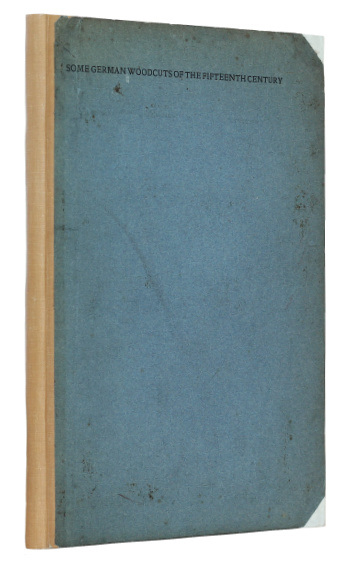
COCKERELL, Sydney Carlyle (editor). Some German Woodcuts of the Fifteenth Century. Hammersmith: ‘printed at the Kelmscott Press’ and ‘Sold by the Trustees of the late William Morris at the Kelmscott Press’, ‘1897’ [but 1898].
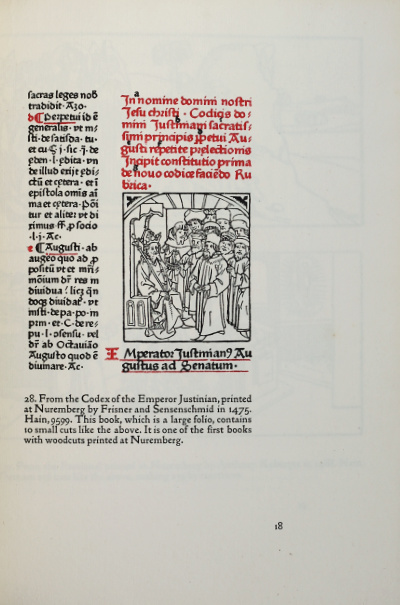
Quarto in 8s (290 x 210mm), pp. [i]-xi (title, verso blank, foreword, blank, preface, ‘A List of the Woodcuts’), [1 (blank)], ‘1’-‘23’ (illustrations with letterpress captions, printed on the rectos only), 24-36 (‘A List of the Principal Books of the Fifteenth Century’, ‘Analysis of the Woodcuts in the Latin Edition of the Nuremberg Chronicle’, colophon), [1 (press-device)]. Printed in Golden type in red and black. Six-line wood-engraved initial and press-device [Peterson printer’s mark no. 2], both after Morris. 35 line-block facsimile illustrations in the text. (Scattered light spotting.) Original boards [by J. & J. Leighton], upper board titled in black, sympathetically rebacked [?in the mid 20th century] with light-brown cloth spine in the style of the original. (Some light marking, board-edges slightly rubbed and bumped, recornered [?in the 21st century].) A very good copy. Provenance: Ananda Kentish Coomaraswamy, Norman Chapel, Broad Campden (1877-1947, friend of C.R. Ashbee and owner of the Essex House Press from c. 1908-1910, his booklabel of c. 1907-1911 [?by the Essex House Press] on upper pastedown; [?]consigned by him to The Anderson Galleries, New York, 24 March 1924, lot 328) – Philip C. Duschnes, New York (mid-20th-century bookseller’s ticket on lower pastedown) – Lawrence Montague Lande, OC (1906-1998, bookplate on upper pastedown).
First edition, one of 225 copies on ‘Perch’ paper from an edition of 333 copies. William Morris owned a large library of books and manuscripts, which was particularly strong in fifteenth- and sixteenth-century German illustrated books, from which he drew inspiration for the books published by the Kelmscott Press. (Perhaps the most notable example of this is found in Morris’s design for the bindings of the 48 copies of the Kelmscott Chaucer bound in white pigskin by the Doves Bindery, which was based on the binding of his copy of a Bible bound in Augsburg in 1478 by Ulrich Schreier.) Morris had ‘asked [Sydney Carlyle] Cockerell “to help him to catalogue his library” on the evening of 19 October 1892 […], and for the next few years Cockerell, in addition to his other duties, studied and catalogued Morris’s extensive collection of incunabula and mediaeval manuscripts. Out of this activity grew Morris’s scheme of a heavily illustrated catalogue of his library, with descriptions by Cockerell and additional notes by himself’ (Peterson). Although trial pages for the projected catalogue were printed and proofed, it was unfinished at the time of Morris’s death, and it was decided by his executors that the book could not be completed.
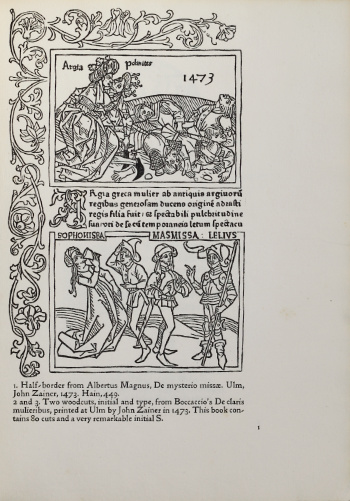
In its place, Cockerell produced Some German Woodcuts of the Fifteenth Century, illustrated with 29 facsimile prints of the books which had already been prepared, together with 6 which ‘were made for [Morris’s] article in the 4th number of Bibliographica on the Early Woodcut Books of Ulm & Augsburg’ (p. iii). Passages were extracted from Morris’s article to serve as a preface (pp. v-ix), which was followed by a list of the illustrations and the illustrations themselves. The volume concludes with Cockerell’s ‘A List of the Principal Books of the Fifteenth Century, Containing Woodcuts, in the Library of the Late William Morris, Arranged Alphabetically According to Towns’ and ‘Analysis of the Woodcuts in the Latin Edition of the Nuremberg Chronicle’. The book attracted numerous pre-publication orders. On 30 November 1897 Cockerell wrote to Leighton (the binders), that ‘[t]here has been a great rush on the German woodcuts & they were all sold out last week […]. A good many people have been left out in the cold, as orders keep coming in! I suppose it is the announcement that the Press is closing that has made people so eager’ (quoted in Peterson). According to the colophon, Some German Woodcuts of the Fifteenth Century was ‘[f]inished on the 15th day of December, 1897’ and published on 6 January 1898 in an edition of 225 copies on paper priced at 30s. and eight copies on vellum priced at 8 guineas.
This copy was formerly in the library of the art historian, curator, and private press proprietor A.K. Coomaraswamy, who had been born in Colombo, Ceylon to the lawyer, politician, and scholar Sir Mutu Coomaraswamy and his English wife Elizabeth. A.K. Coomaraswamy came to England with his mother at the age of two, and was educated at Wycliffe College, Gloucestershire and University College, London, graduating in 1900 with first-class honours in mineralogy and botany. He was elected a Fellow of University College in 1903, and from 1903 to 1906 he was Director of Mineralogical Survey of Ceylon. In 1906 his scientific endeavours – which included the discovery of a new mineral, thorianite – were recognised by the award of an honorary DSc by London University, but he resigned from the Mineralogical Survey of Ceylon later in the same year to pursue his other interests, particularly in the arts and culture of Ceylon and India.
Coomaraswamy probably became aware of Morris’s ideas and work when he was a schoolboy or a student. Both men shared a common ‘view of society and the significance of the artist and craftsman’ (R. Lipsey, Coomaraswamy. 3: His Life and Work (Princeton, NJ, 1977), p. 262), which would remain strong to the end of Coomaraswamy’s life. In 1907, after he had returned to England, Coomaraswamy bought Norman Chapel, a Tudor manor house incorporating an earlier chapel, in the village of Broad Campden. It seems likely that Coomaraswamy and his wife Elizabeth Mary (née Partridge) had been introduced to the area by her brother Fred Partridge, who worked at C.R. Ashbee’s Guild of Handicraft. Ashbee had moved the Guild from Essex House in London to the adjacent village of Chipping Campden in 1902, and with it the Essex House Press, a private press which Ashbee had established in 1898 with printing presses acquired from the Kelmscott Press. Ashbee had altered and extended the house for Coomaraswamy in 1905-1907, and when T.E. Lawrence visited it as an undergraduate, he ‘exulted over “the large living-room with the old open chapel roof”, the “low galleries were screened with Morris chintz”, the “long refectory tables and shelves full of the Kelmscott printings [presumably including this volume]”, the “Morris tapestries”, the “special oak lectern” displaying the Kelmscott Chaucer, and the “very handpress Morris himself had used’ (R. Aldington, Lawrence of Arabia: A Biographical Enquiry (London, 1955), p. 51).
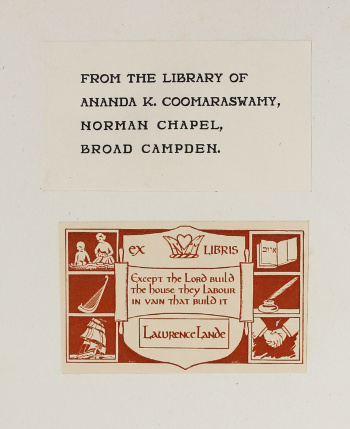
This volume has Coomaraswamy’s booklabel, which is printed in Ashbee’s ‘Endeavour’ type, presumably at the Essex House Press. Although Essex House Press had closed in 1907, during a period of economic recession, Coomaraswamy took over the press, and it reopened in the autumn of that year, housed at Norman Chapel, where it continued until 1910. In 1917 Coomaraswamy took up the position of Curator of Indian Art at the Museum of Fine Art, Boston, MA, and remained at the museum until the end of his life. This example of Some German Woodcuts of the Fifteenth Century was apparently consigned for sale at auction by Coomaraswamy, and it was sold by The Anderson Galleries, New York on 24 March 1924. It was later in the stock of the noted antiquarian bookseller Philip C. Duschnes before entering the library of the noted Canadian writer, bibliographer, and bibliophile Lawrence Lande. Lande – who is best known for his important collection of Canadiana which is held at McGill University – collected books on a broad range of subjects, including literature, music, and politics.
E. Le Mire, Bibliography of William Morris, A-85.01; W.S. Peterson, The Kelmscott Press (1985), A49.
£2,250
· · · · · · · · · · · · · · · · · · · · · · · · · ·
Our Terms & Conditions apply.